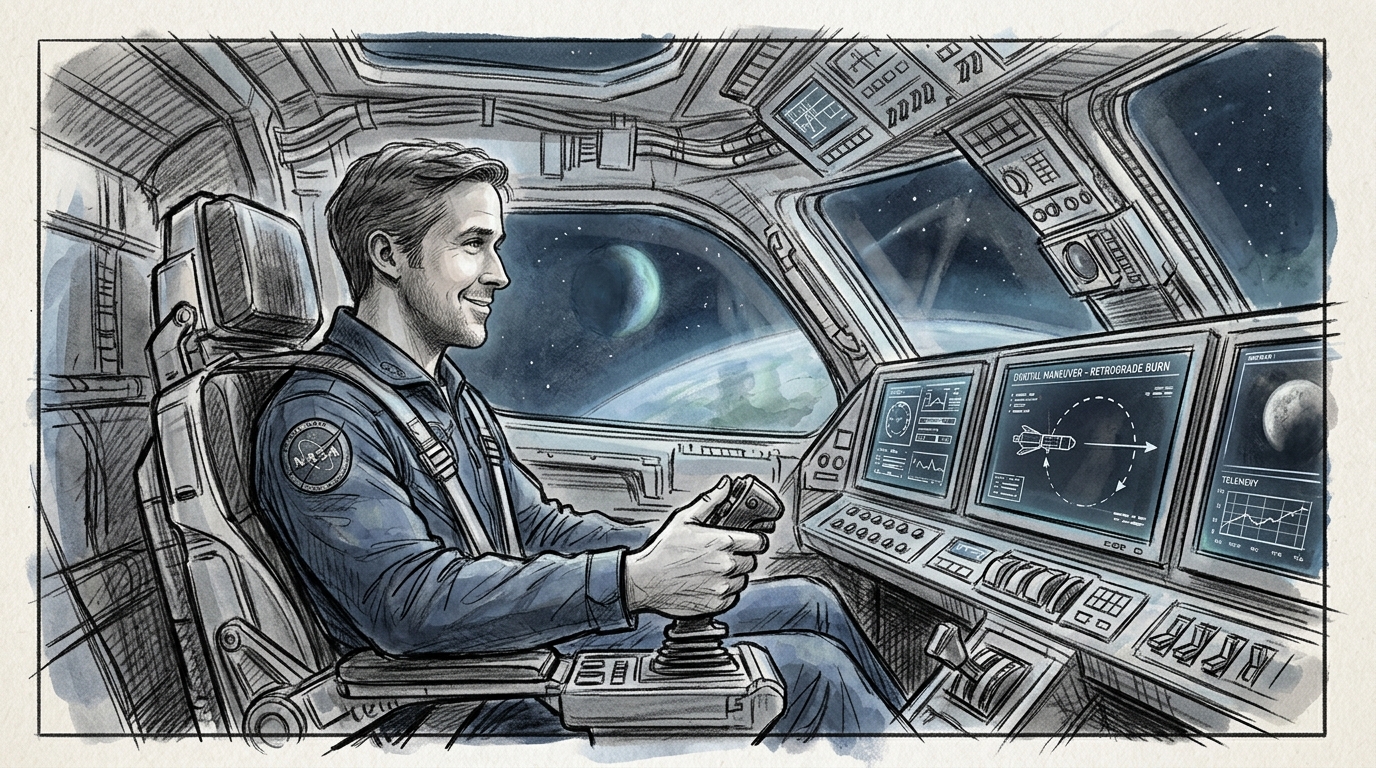
Back in March, I went to the cinema with my eldest child to watch *Project Hail Mary*, a film adapted from the novel by Andy Weir that we had eagerly anticipated for quite some time.
Throughout its nearly three-hour runtime, we were thoroughly immersed in the screen, and even after walking out of the theater doors, a succession of scenes continued to unfold in my mind. Among them, what lingered most deeply was the way two distinct beings—Ryland Grace and Rocky—chose to treat one another.
Dr. Ryland Grace was a scientist dispatched into the far reaches of deep space to prevent Earth’s extinction. As his lost memories gradually return, he is confronted with a brutal truth.
He was not a willing martyr who volunteered to sacrifice his life to save humanity. When he attempted to flee in the face of mortal terror, Eva Stratt, the project’s supreme administrator, had him forcibly sedated into a coma under the banner of the greater good and loaded onto the starship.
Watching that scene on screen evoked a profound sense of unease.
“If the outcome is so paramount, does that justify every act of coercion along the way? Can an individual’s autonomy and choice simply be crushed under the justification of collective survival?”
As someone who has long reflected on ways of working within organizations, this was a question that could not easily be brushed aside.
The Being Who Waited Quietly Beyond the Bulkhead
In stark contrast, the way Rocky, the extraterrestrial being encountered in the middle of unfamiliar space, treated Grace was entirely different.
Rocky belonged to a completely different species, with a different language and cognitive framework. Yet Rocky never rushed Grace until he had processed his fear and was ready.
He never forced a dialogue.
He never pressed Grace to understand things on his own terms or pushed him into a corner.
Instead, beyond the transparent dividing bulkhead, Rocky simply waited in quiet patience until Grace was ready to reach out his hand and open his heart of his own accord.
As those hours of patient waiting accumulated, a rock-solid trust sprouted between them that transcended species and origin.
In the film’s final act, when presented with his sole chance to return safely to Earth, Grace turns his ship around. To rescue Rocky from mortal peril, he relinquishes his only path of survival and heads back into the jaws of death.
No one ordered him to do it. Nor was it done under the coercion of some grand cause. It was a completely sovereign, wholehearted choice made for a friend who had believed in him and waited for him to the very end.
Ultimately, what radically transformed a man’s heart and forged a true hero was not the ruthless command of an administrator who shoved him onto a spaceship, but the steadfast attitude of a friend who quietly waited beside him.
As the Speed of Tools Accelerates, We Must Patiently Wait for Human Pace
This leads us to reflect quietly on the workplaces where we operate.
In project delivery, we often prioritize outcomes, efficiency, and deadlines above all else. We sometimes believe that making people move “faster, more predictably, and immediately upon command” represents competent management and leadership.
Yet behind the outcomes extracted through such pressure inevitably lie the silence of exhausted people and passive compliance. Execution forced through rigid systems and rules while hearts remain unaligned can never endure over the long haul.
Lately, as I experiment with AI, automation, and technical workflows to explore meaningful solutions for organizations, a thought often crosses my mind.
Technology accelerates by the day, and tools grow unimaginably sophisticated. Yet the faster our tools become, paradoxically, the more generously we must allow time for the hearts and capabilities of the people wielding those tools to mature.
The power that truly moves human beings does not stem from coercive commands or systemic control; it emerges from the patient posture of a leader who quietly observes and waits until the individual grasps the meaning and chooses to step forward voluntarily.
With What Attitude Do I Face My Colleagues Today?
Some focus on pressing and pushing colleagues solely to meet predetermined deadlines.
Yet others quietly hold their place beyond the bulkhead until the other person can understand the situation, overcome their fear, and walk forward under their own power. When time passes, the ones who leave behind genuine voluntary commitment and psychological resilience in a team are always the latter.
Leaving the cinema with my child, I posed a quiet question to myself:
Today, am I someone who rushes to shove others into a predefined mold, or am I someone who waits quietly beside them until they find their own path?
In an era of relentless speed and technology, perhaps the most precious capability a leader can cultivate is this serene, unhurried posture of waiting.