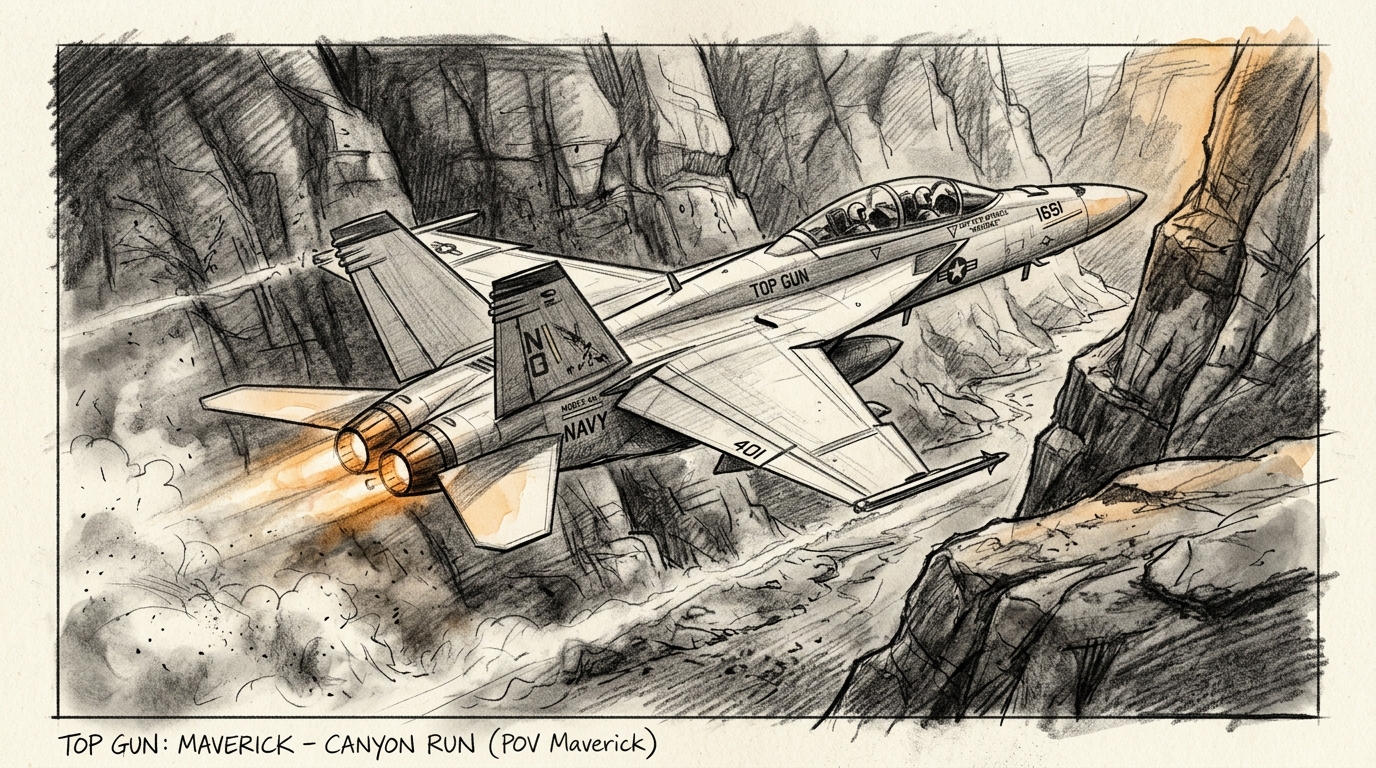
If one were to choose the most unforgettable scene in the movie *Top Gun: Maverick*, it would undoubtedly be the moment when Maverick personally pilots a fighter jet and flawlessly completes the simulated canyon penetration run in just ‘2 minutes and 15 seconds.’
The target time given to the young aviators was 2 minutes and 30 seconds. It was an uncompromising threshold that had to be met in order to weave through enemy surface-to-air missile batteries and return alive from the threat of patrolling 5th-generation stealth fighters. However, the pilots shook their heads, saying it was “practically impossible.” Indeed, throughout the grueling training cycles, not a single pilot came close to reaching that standard.
To make matters worse, a near-fatal training accident occurred, and with the passing of Admiral Iceman—Maverick’s longtime comrade and protector—the command immediately removed Maverick from his instructor post. The mission commander, Admiral Cyclone, issued a new set of compromised parameters, raising the entry altitude and extending the time limit under the premise of higher mission safety. Yet that compromise meant flying straight into enemy radar coverage, virtually sealing the team’s fate with zero chance of survival.
At the very moment the Admiral was briefing this safe-looking compromise in the briefing room, Maverick quietly picked up his helmet and walked toward the hangar.
A solo sortie launched without official authorization from command. Leaving the control tower’s warnings behind as he plunged into the canyon, he never once pleaded with his team, “Trust me.” Instead, he personally lowered the time standard to an even more demanding 2 minutes and 15 seconds, and flawlessly flew the treacherous, unforgiving canyon course all by himself.
Watching the flight in stunned silence from behind the screens of the combat operations center, the team members could no longer call that objective “impossible.”
A Single Demonstration Speaks Louder Than Saying “We Can Do It”
In our workplaces, we frequently encounter daunting, ambitious goals.
From migrating to an entirely new architecture and meeting tight release schedules, to solving complex problems never before attempted. As the difficulty of the objective rises, team members naturally grow anxious and adopt defensive stances.
At such moments, many managers try to break through using mere words and slogans:
Demanding vague optimism by declaring “We can do it,”
Pressuring people with formal authority by insisting “It’s the committed timeline, so make it work somehow,”
And blaming the team’s lack of execution or dedication when results fall short of expectations.
However, cheerleading and top-down directives alone can never truly move people’s hearts. What shatters the disbelief and fear rooted in the minds of team members is not an elaborate slide deck or well-crafted speeches.
It is the willingness of a leader to step directly into the most difficult and uncertain ground, proving with their own hands and actions that the path is genuinely achievable. That was the unmistakable power of the 2-minute 15-second flight Maverick demonstrated.
A Manager Who Demands Compliance vs. A Leader Who Makes You Want to Fly Together
We often define a leader as someone who “leads people from the front.” However, relying on regulations and commands to force people to follow has clear limits.
Maverick did not demand obedience by asserting rank or formal authority.
By shouldering the risk himself and blazing the trail first, he inspired a voluntary conviction from the depths of his team’s hearts: “If that is the path he flies, I am willing to follow him anywhere.”
A compliance-driven approach grinds to a halt the moment oversight and monitoring slacken.
In contrast, a leader who makes people want to fly together empowers team members to take genuine ownership and act autonomously from their respective roles.
The force that truly moves people does not stem from the power granted by job titles, but from the tangible practice of someone who leaped in first and proved what was possible.
Moments When Action Must Precede Words
Before demanding speed and output, we must first reflect on the direction and intrinsic meaning of the work.
When team members hesitate before a new endeavor, it is rarely due to a simple lack of willpower. It is because they have not yet gained conviction on whether the path is truly viable, and whether the hardship is genuinely worth undertaking.
A leader is not a detached observer who merely throws high targets over the fence and watches from behind.
When everyone stops, saying it is impossible, a leader must be the one who willingly shoulders responsibility, moves first, and opens the realm of possibility right before their eyes.
What kind of leadership is present in your organization today? If hollow directives and repetitive meetings are recurring, perhaps now is the exact moment for someone to step up and prove the way forward through action.