After watching the film *Top Gun: Maverick*, the scene that lingered in my mind the longest was not the dazzling aerial dogfights. It was the quiet, profound transformation in the relationships between the team members.
Deep inside enemy territory, Maverick and Rooster were attempting an escape in an outdated F-14 Tomcat when they found themselves surrounded by fifth-generation enemy fighters, seconds away from being shot down. In that final, desperate moment, the pilot who swooped down from high above to destroy the pursuing enemy jet and save their lives was Hangman—the very pilot who had clashed fiercely with Rooster throughout the entire mission.
Seeing someone known for intense individualism and friction dive in without hesitation to save his teammate brought a question to the surface that had long stayed with me:
“How, in the end, is a true team actually built?”
Trust Does Not Bloom Overnight
This transformation was not a sudden miracle that appeared out of thin air. Nor was it because someone simply had an overnight change of heart.
Throughout training, Maverick never barked orders or relied on rigid disciplinary threats. Instead, for pilots who lacked mutual trust and were consumed by personal rivalry, he created daily opportunities for them to struggle, adapt, and collide together. Through shared sweat and intense collaboration, he led them to internalize the reality that they were not competitors, but comrades to whom they must entrust their very lives in the sky.
That solidified change revealed itself quietly just before the final sortie.
Having been left out of the strike team to serve on standby, Hangman swallowed his disappointment, approached Rooster before takeoff, and offered a single short phrase:
“Give ’em hell.”
It was far more than a formal greeting. It was the exact moment when the towering wall of pride and rivalry that had stood between them silently crumbled away.
Moving Beyond ‘Command and Obedience’ to Where ‘Everyone Becomes a Leader’
At the climax of the mission, as he saves the duo from imminent destruction, Hangman radios in with his signature swagger:
“Good afternoon, ladies and gentlemen. This is your savior speaking.”
It sounded playful on the surface, but underneath lay an unshakeable sense of responsibility: no one who flies into battle together gets left behind. He acted without hesitation or excuses, leaping into danger solely to keep his teammates alive.
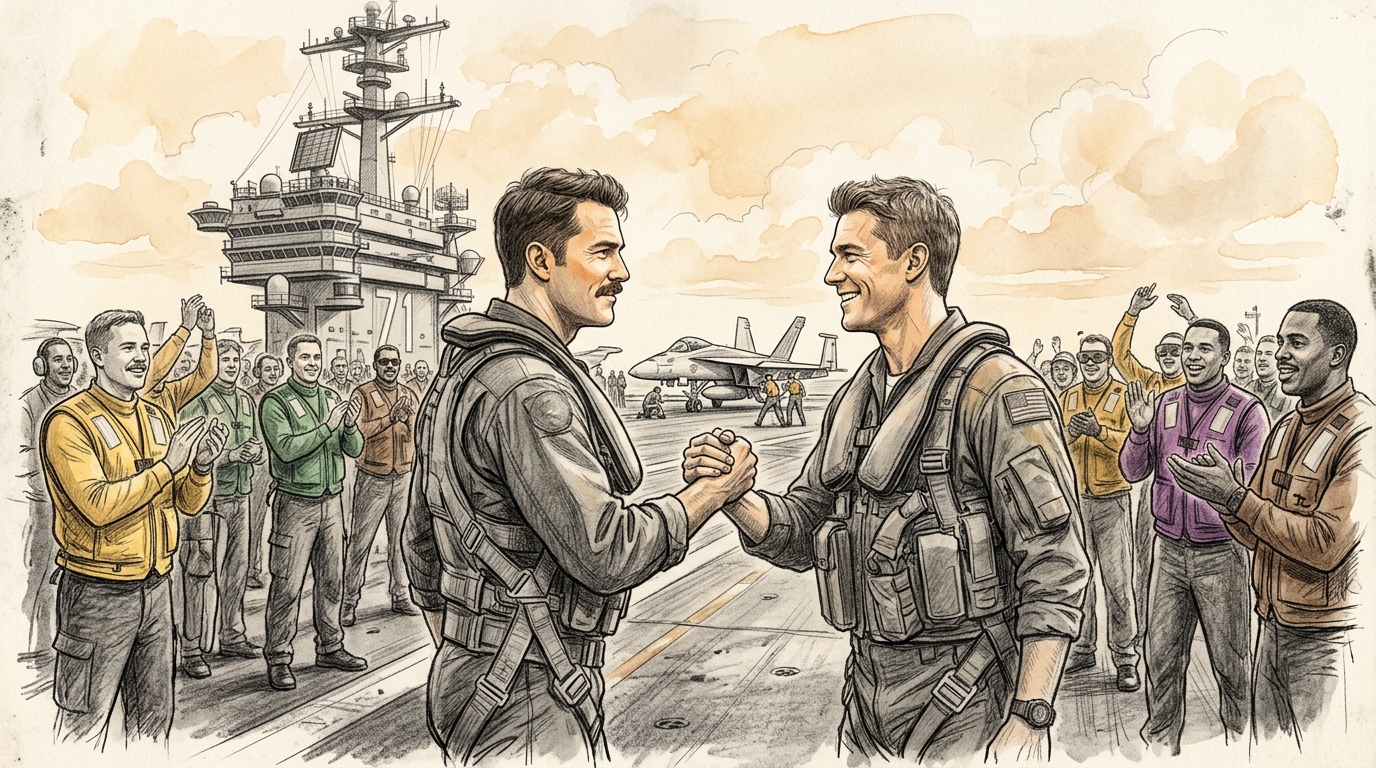
When they finally landed safely on the aircraft carrier flight deck, Hangman and Rooster looked at each other, smiled without words, and firmly grasped each other’s hands.
It was not a staged, artificial reconciliation; it was the quiet relief and mutual trust of professionals who had crossed the line of fire together and recognized one another as a true team.
I felt that this exact moment was both the pinnacle of leadership and the birthplace of genuine teamwork.
It was not a one-way hierarchy where one person pulls from above and everyone else follows blindly. In the moment of crisis, each individual evaluated the situation independently and willingly took on responsibility for their fellow teammates. Maverick was not the only leader; Rooster, who delivered his part, and Hangman, who flew in to rescue his colleagues, had all stepped up as leaders in their own right.
How Is Your Team Flying Today?
This prompts us to look back at our own workplaces.
We gather under the umbrella of a single project, but are we so absorbed in our own positions and immediate metrics that we overlook the struggles of the colleagues sitting right next to us?
There are organizations that draw rigid lines around their individual job descriptions and stop, declaring, “My part is done.”
On the other hand, there are organizations where, when problems arise, people step forward without calculating personal gain to fill in the gaps for one another.
What creates that difference is never a grand slogan.
It is the consistent, quiet posture demonstrated by leaders in the field every single day, and the deep, shared trust among team members who step beyond passive execution to take collective ownership of the outcome.
Is the team you are part of today watching out for one another and flying forward together? Or are people merely guarding their own seats in heavy silence?