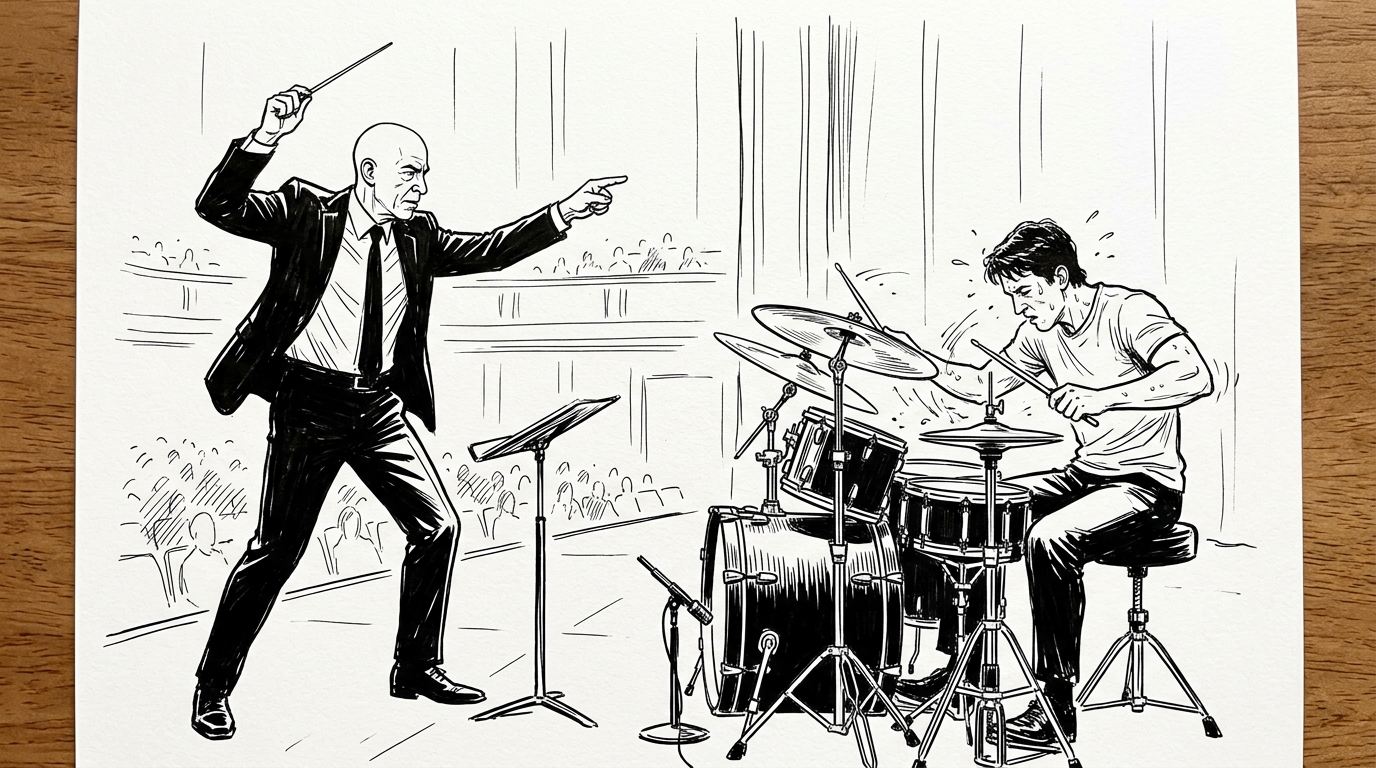
The film Whiplash overwhelms viewers with intense performances, frenetic direction, and the razor-sharp rhythm of jazz drumming. It is also the cinematic breakthrough that permanently etched director Damien Chazelle’s name onto the global stage, long before his worldwide success with La La Land.
Yet, this masterpiece did not begin with a massive budget or lavish studio backing.
Originally written as an 85-page feature screenplay, finding an investor willing to pour a huge sum into a rookie director’s obscure jazz indie film was nearly impossible.
What if the director had insisted on waiting until all resources and perfect conditions materialized, obsessing only over a full-scale feature from day one? Most likely, this story would have sat buried inside a drawer, never seeing the light of day.
Delivering Small Increments Before Demanding Grand Plans
Faced with a lack of funding, Chazelle chose a pragmatic strategy: ‘Prove value by slicing it small.’
He carved out a key scene from the screenplay—where the protagonist Andrew enters the studio band and endures Professor Fletcher’s brutal first rehearsal—and filmed it first as an 18-minute short.
It was a small pilot project, or in software development terms, a ‘Minimum Viable Product (MVP)’ released to the world.
The experiment paid off brilliantly. Winning the Short Film Jury Award at the 2013 Sundance Film Festival, the short publicly demonstrated the story’s raw potential. That validation secured the full-scale funding required to create the legendary feature film we know today.
In business and project delivery, we often fall into the trap of waiting for the ‘perfect setup.’ We spend months refining master plans and defer execution until headcount and budget feel comfortable.
Yet real-world dynamics rarely obey pre-packaged plans; market shifts and unforeseen variables constantly intervene. Rather than trying to paint a massive canvas all at once, launching the smallest testable slice to validate real feedback is a far more realistic and formidable approach.
‘Touché’: The Courage to Acknowledge Being Touched
When executing in small iterations and harvesting feedback, we inevitably encounter feedback.
A fencing term comes to mind that I heard years ago in a lecture: ‘Touché’.
Originating from French meaning “touched,” this is the expression a fencer calls out themselves when an opponent’s blade tip lands on their body. In that split second, the fencer feels the touch on their own skin long before the referee registers it.
Only a competitor who sets pride aside to humbly declare “I am touched” can fix their vulnerabilities and elevate their craft to the next tier.
The professional workplace operates no differently.
Whether there are flaws in our code, flaws in our system architecture, or logical gaps in our product strategy—the creator senses it first before anyone points it out.
However, as tenure increases and ego takes over, people tend to make excuses or adopt defensive postures to cover visible gaps. Hiding behind tools or blaming others robs the team of the chance to rectify real problems.
Without the self-awareness to humbly admit “I missed this” or “there is a defect here,” no agile framework or sophisticated toolchain can move a team one step forward.
Feedback Must Be a Stepping Stone for Growth, Not Control
Professor Fletcher drove his musicians off a cliff, claiming that “there are no two words more harmful than ‘good job.’”
Yet unilateral verbal abuse aimed at tearing someone down never elicits a genuine ‘Touché’. Instead, it shrinks individuals into fear, forcing them to conceal mistakes and shut down communication lines.
Healthy feedback is not a weapon of dominance; it must be a safe mirror allowing teammates to candidly share their vulnerabilities.
When an environment exists where people feel safe admitting flaws, sincere encouragement like “thank you for your hard work” or “you solved this tough problem well” becomes a solid stepping stone for a bigger leap, rather than an excuse for complacency.
The One Step We Need Today
Just as director Damien Chazelle abandoned the illusion of an immediate grand feature to shoot an 18-minute short first, and just as a fencer calmly calls out ‘Touché’ the moment a blade touches skin.
The posture required of leaders and teams navigating uncertainty is remarkably simple and clear.
Rather than wasting time at a desk waiting for perfection, put a small, validated piece out into the real world today. And rather than dodging the gaps revealed along the way, face them candidly and iterate together with your team.
That is the most authentic execution and learning mindset we must seize every day on the frontline of uncertain projects.
Is your team hiding behind a grand plan today, or taking a small but definitive step forward?