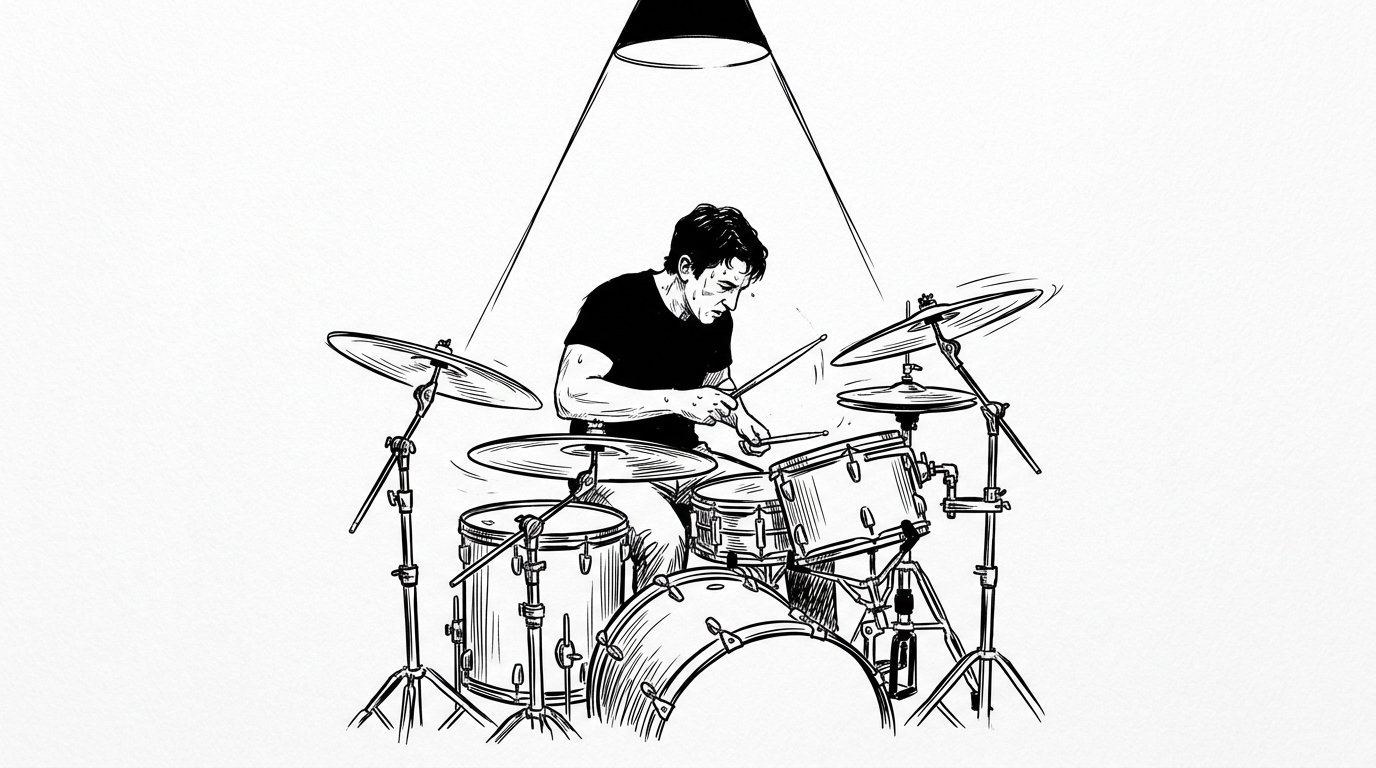
I remember feeling a lingering sense of discomfort throughout the entire running time of the movie Whiplash.
The protagonist, Andrew, plays the drums while wrapping band-aids around his bleeding hands. Pushed to the precipice under the relentless verbal abuse, insults, and flying cymbals of Professor Fletcher, Andrew ultimately delivers a breathtaking, insane solo performance in the final scene.
While some describe that breathtaking climax as a pinnacle of artistic achievement transcending human limits, what remained in my eyes was exhaustion, terror, and a human soul broken beyond repair.
Whenever I step into leadership roles responsible for delivering outcomes in real-world projects, the shadow of Professor Fletcher looms uncomfortably close.
The Fallacy Behind “There Are No Two Words More Harmful Than ‘Good Job’”
In the film, Professor Fletcher declares:
“There are no two words in the English language more harmful than ‘good job.’”
His point was that moderate satisfaction and compromise erode human potential. In fast-paced business environments, a strikingly similar logic often takes hold. When deadlines loom or major service releases approach, more than a few leaders believe that driving team members to the edge through intense pressure is the only way to squeeze out quality.
To be sure, backing people into a corner can yield short-term results. Bugs are patched overnight, and milestones are forcefully met.
But what remains behind such squeezed outcomes?
The motivation to tackle the next project bottoms out, and core engineers leave the team one by one. What remained in Fletcher’s band was not a squad of inspired musicians, but terrified performers constantly walking on eggshells to dodge the next flying insult. Any management style that holds people hostage through fear is inherently unsustainable.
Praise Is Not Compromise, But ‘Acknowledgement of Reality’
People usually know the quality of their own work before anyone else says a word. Whether code quality is lacking, a product feature has blind spots, or an architectural design is overstretched—the creator feels it first.
This is not about handing out mindless, superficial praise for substandard work. Conversely, a genuine “thank you” or “great job” offered for stepping up under difficult conditions does not breed complacency.
True feedback is not a blade thrown to break someone’s spirit and exert control. It must be a mirror that helps them face reality as it is.
When the effort and dedication invested in the process are properly recognized, people drop their defensive postures and proactively ponder better solutions. Where only cold criticism devoid of recognition remains, genuine engagement will never flourish.
High Standards and Psychological Safety
In project execution, I frequently hear concerns like: ‘If we overly focus on psychological safety and cater to feelings, won’t we miss deadlines and compromise quality?’
However, psychological safety does not mean superficial harmony or mediocre complacency where people let mistakes slide for the sake of peace.
Truly high-performing teams pair two essential forces: uncompromised high standards, and an environment where mistakes and unexpected issues encountered along the way can be exposed transparently.
- Blameless Problem Solving: When bugs or system outages occur, instead of hunting down “who did it,” the team collectively conducts a post-mortem to uncover “what systemic vulnerability allowed this issue to happen.”
- Freedom to Ask Questions: Only when there is certainty that admitting ignorance won’t get someone labeled as incompetent will bottlenecks be shared early, preventing small issues from turning into catastrophes.
- Normalizing Honest Feedback: Instead of one-way performance lectures, team members candidly exchange ideas to elevate the final product quality.
Some might argue that Professor Fletcher’s extreme methods served as a catalyst for breaking past human limits. However, from the perspective of a leader pondering sustainable growth, it prompts us to reflect not just on having high standards, but whether a ‘safe ladder’ was provided to reach those standards.
Are We Conductor-Leaders, or Whip-Wielding Managers?
Short-term outputs can be forced through fear and intimidation. But in complex knowledge work where teams must solve novel problems and create business value, a brain gripped by fear can never unlock creative solutions.
Just as tools and processes cannot replace human interaction, coercive control can never replace voluntary commitment from colleagues.
There comes a time when every leader must ask themselves: Is what I hold in my hand a conductor’s baton to unleash potential, or merely a whip swung to hit deadlines?
Are your team members trembling with anxiety in front of their monitors, or are they willingly asking questions to build a better product together?
Enduring excellence never grows from fear. It flourishes only upon a foundation of mutual trust and a safe environment.