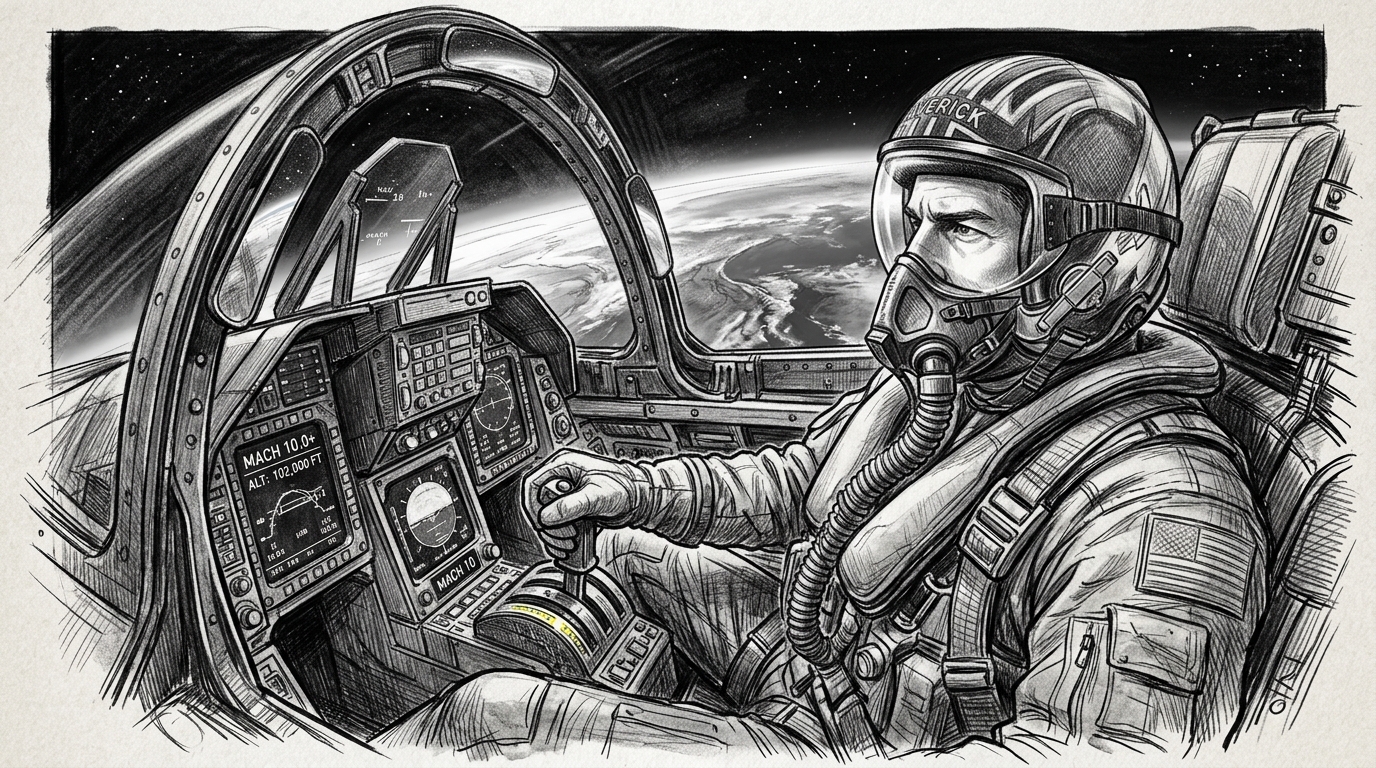
There are many scenes in the movie Top Gun: Maverick that leave a deep impression on the heart. Among them, the scene early in the film where Maverick boards the hypersonic test plane ‘Darkstar’ to challenge Mach 10 goes beyond mere spectacle—it poses a weighty question about work attitude and the essence of leadership.
The original test planned for that day was Mach 9, but in order to prevent the cancellation of the project, they had to prove Mach 10, the final contractual goal. However, news arrives that Admiral Cain, who intends to reallocate the budget to unmanned aircraft programs, is personally heading to the airbase to shut down the project. The moment the Admiral arrives and issues the order, years of sweat and dedication poured in by the engineering team would be scrapped instantly.
Just before the Admiral crosses the base gate, Maverick hurriedly puts on his helmet and climbs into the cockpit.
It was a dangerous choice that defied higher command, but he had a reason clearer than anyone else’s. It was not simply to set a personal flying record, but a resolute decision to prevent the time and effort of his colleagues—who believed in the value of manned flight and worked day and night—from vanishing into thin air.
“Did You Follow the Process?” vs. “Do You Know Why You Are Doing It?”
The result led to breaking Mach 10, the aircraft exploding, and a miraculous survival. Even setting aside the cinematic dramatization, in my eyes, he appeared as a person who understood most clearly ‘Why this work must be done.’
Our work environments are very similar.
Once a project starts moving, voices asking “Are we following the defined processes and rules well?” are loud and plentiful. People become absorbed in changing ticket statuses, filling out status report templates, and checking off milestones according to schedule.
However, the fundamental question—”Can we explain to ourselves why we are doing this work right now?”—gradually gets forgotten.
Even if you are strictly following regulations and procedures without a flaw, if your colleagues are moving like mechanical parts having lost their sense of purpose, that flight can never be sustained for long. Process is merely a means to achieve an objective; it can never be the end in itself.
A Manager Who Demands Compliance vs. A Leader Who Makes You Want to Fly Together
Maverick’s appearance in the cockpit of the Darkstar is completely different from the manager attitudes we are accustomed to seeing.
He did not sit comfortably in a safe command control room urging team members forward or shifting blame. He stepped up first into the most uncertain and dangerous position. The reason ground engineers silently supported his seemingly reckless flight was because they knew it stemmed from genuine devotion to the work and long-established trust, not from authority or directives.
There are managers who force people to comply using job titles and formal authority.
On the other hand, there are leaders who personally grasp the essence of the work, take the initiative, and make people feel: ‘If I am with that person, I willingly want to take flight together.’
The force that inspires voluntary engagement in people comes not from coercive rules, but from the actions and accountability demonstrated directly by the leader.
What Is Your Project Taking Off For?
In an environment that overemphasizes efficiency, performance metrics, and rapid speed, we frequently miss the essence. When we are consumed only with introducing new methodologies and tools to shorten schedules, we end up forgetting what this work actually means to customers and our team.
As speed accelerates, we must ask ourselves more honestly:
On what grounds are we continuing this busy schedule and execution right now?
Are we missing the true value and purpose of our work because we are chased by routine reporting and deadlines?
At the moment when we should be asking “Is this direction truly right?”, are we moving merely out of familiar momentum and habit?
A true leader is not someone who simply shouts the start signal first or urges more speed. A true leader is someone who constantly reminds us—even amid deep uncertainty—why we gathered in this place to take off.
Sharing the meaning of work with colleagues and ultimately embodying an attitude that makes others want to fly together—that is the very essence of leadership that all of us working in the field must hold in our hearts.